
Protocol
A General AI Is Not Your Protocol
A crew is on scene and somebody wants a dose. A phone comes out. The answer arrives in two seconds, written in confident, clean English, and it sounds exactly like the kind of thing a protocol would say.
The speed is not the problem. The question worth asking your crews is a different one: whose answer was that?
A general assistant answers from the average
A general-purpose AI assistant has read an enormous amount of published material — textbooks, journal articles, course notes, other agencies' documents, forum threads, and a great deal that nobody would call a clinical source at all. What comes back is a synthesis of all of it. It is often a reasonable synthesis. It is fluent, it is well organized, and it reads as though somebody in authority wrote it.
Nobody in authority did. Your medical director did not write it, review it, or approve it. It is a national average of everything the model has seen, shaped into a sentence.
Protocols are local, and that is the entire point
Everyone reading this already knows the ways two neighboring services differ. Drug choice, dose and concentration. Route. What a standing order covers and what needs a call for orders. Which skill sits at which level. Which facility takes which patient, and how far the crew is expected to drive to get there.
Those differences are not accidents or inconsistencies to be smoothed out. They are decisions — made by a named physician, for a named service, in a particular county, with a particular set of receiving facilities and transport times. The whole reason your agency has protocols rather than a textbook is that the local answer and the general answer are not always the same answer.
And they move. When your medical director changes something, it changes for your service on the day it takes effect. A general model has no way of knowing that happened, and no reason to tell the medic asking.
No version, no author, no date
A protocol document carries three things that every clinical reference needs: who issued it, which version it is, and when it took effect. Those three things are what let you train against it, audit against it, and say afterwards what was in force on the day of a call.
A chat answer carries none of them. There is no author to ask, no revision number, no effective date, and no guarantee that the same question tomorrow returns the same answer. It cannot be reviewed in QA, because there is nothing stable to review. It cannot be cited in a chart, because there is nothing to cite.
On a call, whatever is in front of the crew is the answer
This is the part that turns a theoretical concern into a practical one. In a quiet room, a medic can read an AI answer, notice it does not match the standing orders, and go and check. On a call at three in the morning there is no quiet room and no second look. Whatever is on the screen is what gets acted on.
The risk is not really one bad answer. It is the habit. The tool that answers fastest becomes the tool that gets asked, and once a crew is in the habit of asking it, they are no longer reading the protocol at all.
The exposure does not sit with the tool
The medical direction is the agency's. The license is the provider's. The chart says treatment was given per protocol, and that line has to be true. A general-purpose assistant has no standing in any of that — it is not credentialed, it is not accountable, and it will not be at the review.
This is not an argument against technology
It is an argument about the source. A crew should absolutely be able to find the right page in seconds; paper in a jump bag was never the ideal either. And away from the patient, a general assistant can be genuinely useful — studying, drafting a lesson, summarizing a published guideline you then go and read for yourself.
The line is the patient. At the patient's side, the only acceptable source is your service's current, approved document.
What to ask of any reference your crews use
- Whose document is it? Your agency's own protocols, or somebody's general reference.
- Who can change it, and how fast does the change reach the crew? If an update takes a month to arrive, the crew is working from last month.
- Does the medic see a version and a date on the page they are reading, without hunting for it?
- Does it work with no signal? Basements, rural county lines, and steel buildings do not care how good the tool is.
- Can you show, later, which version was in force on the day of a particular call?
A general AI assistant fails the first question, and once it has failed the first one the rest do not matter.
Where we come into this
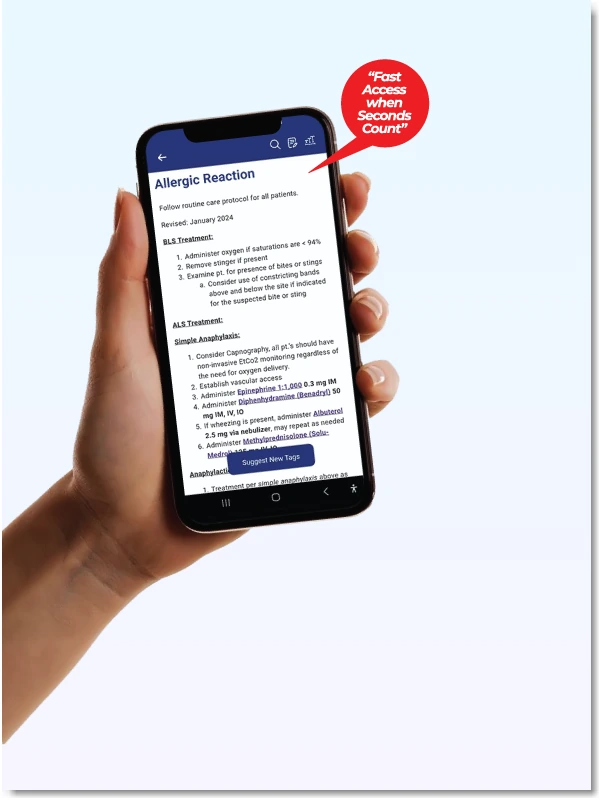
That list is more or less the reason EMS Protocols To-Go exists: your agency's own protocols on the crew's phone, working offline, loaded and kept current by your own administrator through the admin portal, where each protocol carries its revision date. It is a reference tool, not a decision-maker — it does not answer questions and it does not replace judgment. It puts your service's own document in front of the person making the call.
Write the rule down
Most agencies have never said, in writing, which references are approved for patient care and which are not. Until somebody does, the phone in the medic's hand makes that decision, one call at a time. It is a short policy to write and an awkward one to explain afterwards if it was never written.